Installation of solar panel mounting structure on the ground, soil
Installation of solar panel mounting structures on the ground, soil and grounding of panels
The use of solar panel systems is becoming increasingly widespread, not only on roofs but also in ground-mounted solutions. Ground-mounted solar panel mounting structures are an excellent alternative if the roof surface is not ideal or if a larger area is available. These solutions are versatile, but proper design and installation are essential for efficiency and safety.
In addition to selecting the type of support structure and mounting method for ground-mounted systems, it is also important to consider advanced options such as solar tracking systems. The correct installation of solar panels is critical not only from a mechanical point of view, but also from an electrical point of view – grounding plays a key role in protecting against electric shock and ensuring the durability of the system.
In our article, we also discuss why it is not recommended to build your own solar panel support structure and what practical advice you should follow based on SOLARKIT's experience. If you want to install a ground-mounted solar panel system, this guide will take you through the steps in a professional and easy-to-follow manner.

Advantages and challenges of ground-mounted solar panel systems
Ground-mounted solar panel mounting systems allow the panels to be optimally positioned—higher, facing south and at the ideal angle—resulting in up to 20–25% higher output compared to roof-mounted systems. In addition, ground-mounted systems allow for larger, freely expandable systems and can be combined with bifacial panels, which also utilize light reflected from the ground.
However, ground-mounted systems do not only offer advantages. The initial investment is more expensive because new structures and foundations are required, and additional permits may also be necessary. The quality of the soil, wind load, rainwater drainage, and soil erosion must be taken into account to ensure the safe construction of the structure. Furthermore, larger areas may require more maintenance, such as cleaning and regular inspection of structural components.
The number of ground-mounted solar power plants is also growing in Hungary: at the end of 2023, more than 5.8 GW of capacity will be in operation in the country, a significant proportion of which will be ground-mounted systems. These industrial-scale projects, such as the solar power plants in Pécs and Százhalombatta, clearly demonstrate that ground-mounted installations can be a long-term investment with well-thought-out environmental and cost management.
Types of ground-mounted solar panel mounting structures
There areseveral types of ground-mounted support structures for solar panel systems to choose from – it is important to adapt the solution to the soil conditions and the purpose of the system. Here are the most common types that have proven themselves in practice:
1. Fixed-tilt mounting structure
A simple, stable structure fixed at a controlled angle, which keeps the panels at an angle appropriate to the geographical latitude and local conditions, thus reducing investment costs. No machinery or electronics, fewer moving parts, low maintenance – the ideal choice for small systems.
2. Tracking systems
Movable, with single-axis or dual-axis tracking: single-axis tracking performs daily movement, while dual-axis tracking tracks the entire sky, optimizing performance both within a day and seasonally. Production increases of up to 25% compared to fixed mounting structures; particularly useful for larger installations or IPP systems. Single-axis and dual-axis tracking are very different from each other. Dual-axis is a good choice for very small installations, while single-axis is ideal for medium and larger installations.
3. Pole-mounted support structure
One or more panels are mounted on a single pole, sometimes with adjustable tilt and rotation axes, less often combined with a tracking mechanism. Low land requirements, simple structure – suitable for home or small industrial use, especially in limited areas.
4. Concrete, ballasted support structure
A system weighted with concrete or steel concrete blocks that does not require ground penetration – ideal for protected or temporary locations, such as foil-covered surfaces.
5. Special adaptive and alternative systems
Systems adapted to specific conditions, such as windbreaks, agricultural areas or shaded environments – they can be built in a raised design, mounted on railings (e.g. noise barrier solar panels) or in an agrivoltaic combination.Modular,
stainless steel or aluminum versions with adaptive geometry are available for Hungarian conditions, for example from IKARUS.
Summary:
Fixed tiltis an ideal, simple and cost-effective solution.
Tracking systems achieve higher performance but are more complex and expensive, and also take up more space as they require larger row spacing.
Pole and ballast structures are movable, stationary and easy to install.
Specialized systems are flexible and can be adapted to specific needs, especially in agriculture, noise protection, or difficult terrain.
Sun-tracking solar panel mounting structure for ground and soil
The essence of sun-tracking support structures is that the panels continuously adjust to the movement of the sun, enabling them to operate at an optimal angle of incidence for longer periods of time. The big advantage of this is that they generate up to 30-50% more energy than fixed systems, but of course the size of the solar panel remains an important factor.
Single-axis vs. dual-axis tracking
Single-axis systems – which generally follow the Sun in an east-west direction – provide 20-25% more energy per year than fixed structures.
Indual-axis systems, the panels follow both daily and seasonal movements, which can increase annual production by up to 45–50%.
General advantages of solar tracking systems:
- Increased electricity output throughout the day.
- More efficient land use, less panel weight is required compared to fixed structures.
- Particularly advantageous for larger systems with high electricity consumption.
General disadvantages of sun tracking systems:
- More expensive installation and maintenance due to moving parts.
- Frequent checks are required to minimize malfunctions, and every additional moving part carries a risk.
- Correct installation and shadow-free design are required, otherwise nearby panels may shade each other.
Ground-mounted tracking systems offer outstanding yields, especially for larger, industrial or agrivoltaic systems. The single-axis solution is cost-effective and reliable, while the dual-axis structure maximizes yield – however, both require more maintenance and higher investment costs compared to fixed mounting structures.
Different ground-mounted solar panel installation methods
The installation process for ground-mounted solar panel support structures consists of several steps, the precise sequence and thorough execution of which guarantee the long-term stability and performance of the system:
1. Soil preparation and landscaping
Levelling the ground before installation is a basic requirement for precise installation, especially on sloping or uneven surfaces. Soil strength analysis helps to determine whether ground screws, concrete or ballast foundations are required, depending on the model. In many cases, the use of a gravel bed or geotextile is recommended to optimise weed growth and drainage.
2. Type of foundation
- Ground screw fastening: a quick, low-impact method, ideal for loose soils.
- Concrete foundation: recommended especially for larger systems, such as tracking systems or column solutions, providing more secure and durable support.
- Ballast foundation: a prefabricated concrete block system that does not require soil excavation – ideal for leased properties and temporary installations.
3. Assembly and fastening of the supporting structure
The components of the structure (e.g., steel columns, rail supports) must be assembled according to the manufacturer's instructions, with precise angle adjustment and bolting. For larger systems, a crane or mechanical lifting method may help to position the components precisely.
4. Fastening and adjustment of panels
The panels are fastened with special clips or clamps – follow the recommendations of the solar panel mounting system manufacturer. Ensure adequate spacing between the panels to prevent shading from reducing production.
5. Electrical connection and grounding
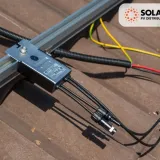
Groundingof a ground-mounted solar panel system is essential: a potential-free connection to the ground protects the system and users from electric shock. During grounding, metal support structures and fittings are connected to the ground potential with a green-yellow conductor. The use of short-circuit protection and surge protection devices is recommended to increase safety.
6. Follow-up inspection and maintenance plan
The stability of the structure and its assembled components must be checked regularly, especially after windy weather and at the beginning of each season. Keeping the panels clean, tightening screws and checking ground connections are essential for long-term operation.
The installation of solar panels on the ground rests on several pillars: landscaping, selection of a suitable foundation, mechanical installation, electrical installation, grounding, and maintenance are all key.Each step must be carried out carefully to ensure that the system operates properly, safely, and for a long time. It is clear that other considerations are more important than when installing solar panels on a roof.
Why is it essential to ground a solar panel system?
Grounding a solar panel system is not only a legal requirement, but also a fundamental safety and operational requirement.
Touch protection and human safety
In the event of a malfunction or insulation problem, the metal support structure and panel frames may become live. Proper grounding diverts excess current to the ground, which can prevent electric shock accidents.
Overvoltage and lightning protection
Direct or indirect lightning strikes can cause serious damage to the inverter or panels. Grounding provides a low-resistance path for these overcurrents – even with special protection (lightning arresters, SPDs) – which increases the long-term service life of the system.
Device protection and system efficiency
Grounding is not only protection, but also system optimization: it reduces electrical noise and interference and improves system performance. In addition, it helps prevent panel damage caused by PID (Potential Induced Degradation).
Groundingsolar panel mounting structures and panels is essential for protecting human life, equipment, and the reliable operation of the system. A well-designed, standard-compliant touch and surge protection system is part of the grounding system.
DIY solar panel mounting system? It's not worth it!
Installing a solar panel support structure yourself may seem like a cheap and attractive solution at first, but it comes with a number of risks:
Improper sizing and structure
Choosing the right support elements is complicated: you have to choose from a variety of material qualities, load-bearing capacities and structural elements. An improperly dimensioned system may deform or even collapse over time.
Safety issues, liability issues
Hungarian standards (e.g. MSZ HD 60364-7-712) require touch and overvoltage protection, which is difficult to achieve with homemade designs. This can lead to serious accidents or financial liability.
Loss of warranty, improper installation
Some manufacturers only provide a warranty for systems that have been certified by a qualified installer. Unauthorized or improper installation voids this legal protection and makes any subsequent expansion more difficult.
Lack of quality control
With home installation, there are no regular checks – for example, fastenings, ground connections or checks for material defects in structural components may be omitted.
Overall: although the "do-it-yourself" option may seem attractive at first glance, it is much riskier in the long run due to the loss of reliability, safety, and warranty. Involving a competent installer provides you with a stress-free, legally and technically professional solution.
SOLARKIT practical tips for contractors
Based on SOLARKIT's experience, these are the most important practical tips for those who want to install a ground-mounted solar panel system:
Consult with your electricity provider about billing methods
Before designing the system, it is worth clarifying the billing structure (gross or net metering), as this can affect the sizing and return on investment.
Select an experienced, registered contractor
A reliable contractor is essential to ensure the quality of the materials, installation, and documentation. In SOLARKIT's experience, references, registration, and warranty are basic requirements.
Preparation of a detailed, transparent offer
Always request a quote that includes itemized design, licensing, material, and installation costs to avoid "hidden costs."
Avoid common installation mistakes
SOLARKIT's webinars draw attention to neglected foundations or the installation of inaccurate metal components, which can later lead to structural or electrical problems.
Post-installation inspection and consumption measurement
After installation, it is advisable to integrate a smart consumption meter and check that the inverter is actually delivering optimal performance ("smart consumption measurement" – based on SOLARKIT videos).
Follow the latest tips on the blog and social media
The SOLARKIT blog and webinar regularly share new tips, e.g. on how to charge an electric car smartly from an off-grid solar panel.
Ground-mounted solar systems are no longer just for agricultural and industrial investments – more and more households are also using this solution. Choosing and installing the right solar panel mounting system on the ground is not only economical in the long term, but also ensures a stable, easy-to-maintain and expandable system.
Fixed or sun-tracking solar panel mounting systems on the ground offer different levels of yield, installation costs and maintenance requirements. When choosing between the various installation methods – ground screws, concrete or ballast solutions – the soil structure, installation time and environmental impact must be taken into account.
Proper grounding is one of the cornerstones of safe system operation: it not only provides protection against electric shock, but also protects electronic components and increases the service life of the system. Although DIY installation may be tempting, in practice it has many pitfalls – improper mounting, lack of electrical protection or control deficiencies can lead to serious problems.
SOLARKIT's practical advice will help you avoid the most common mistakes and choose a mounting system that will serve your solar power system for many years to come – safely, efficiently, and in compliance with all regulations.