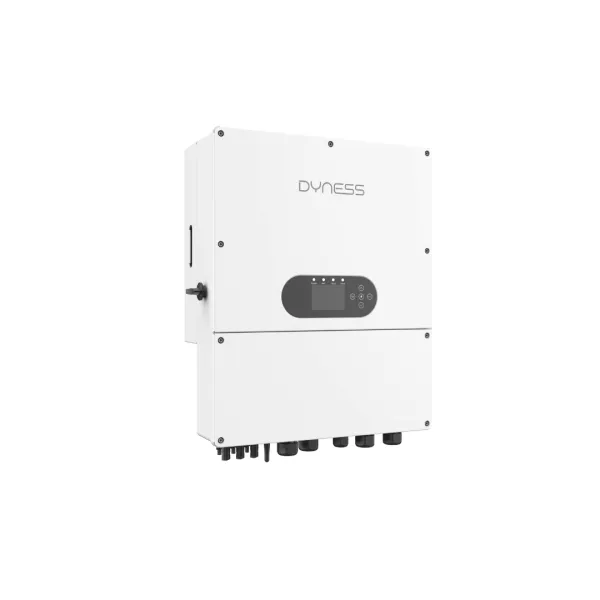
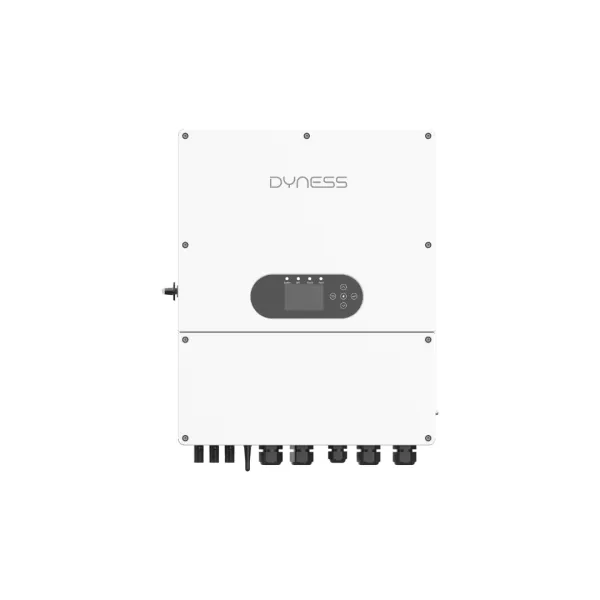
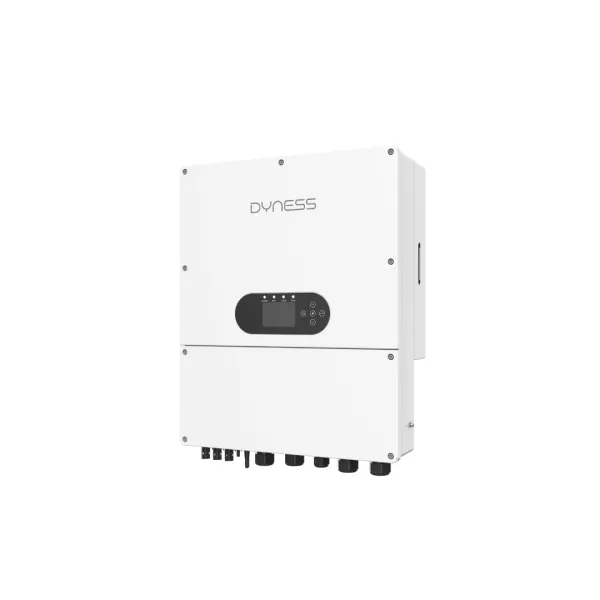
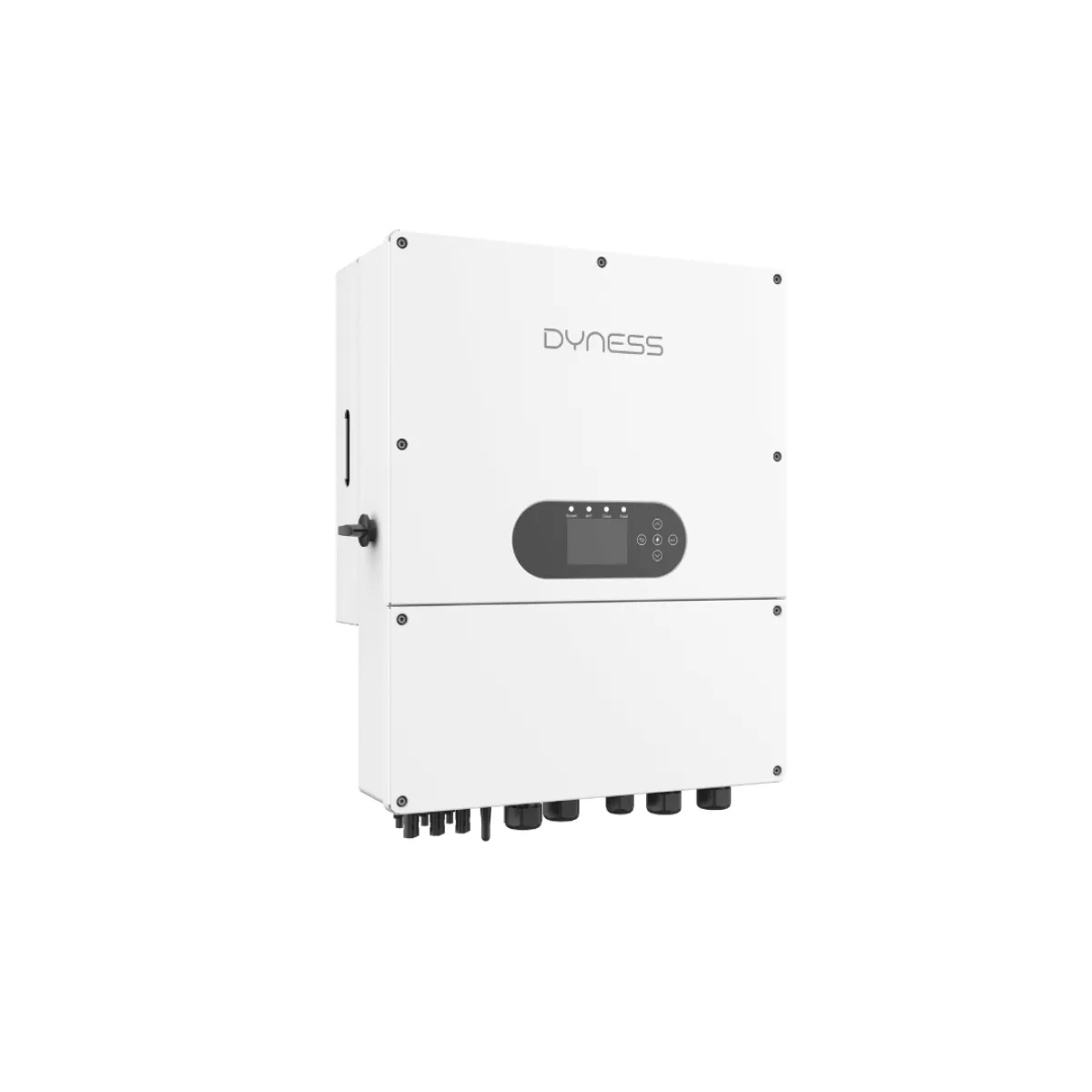
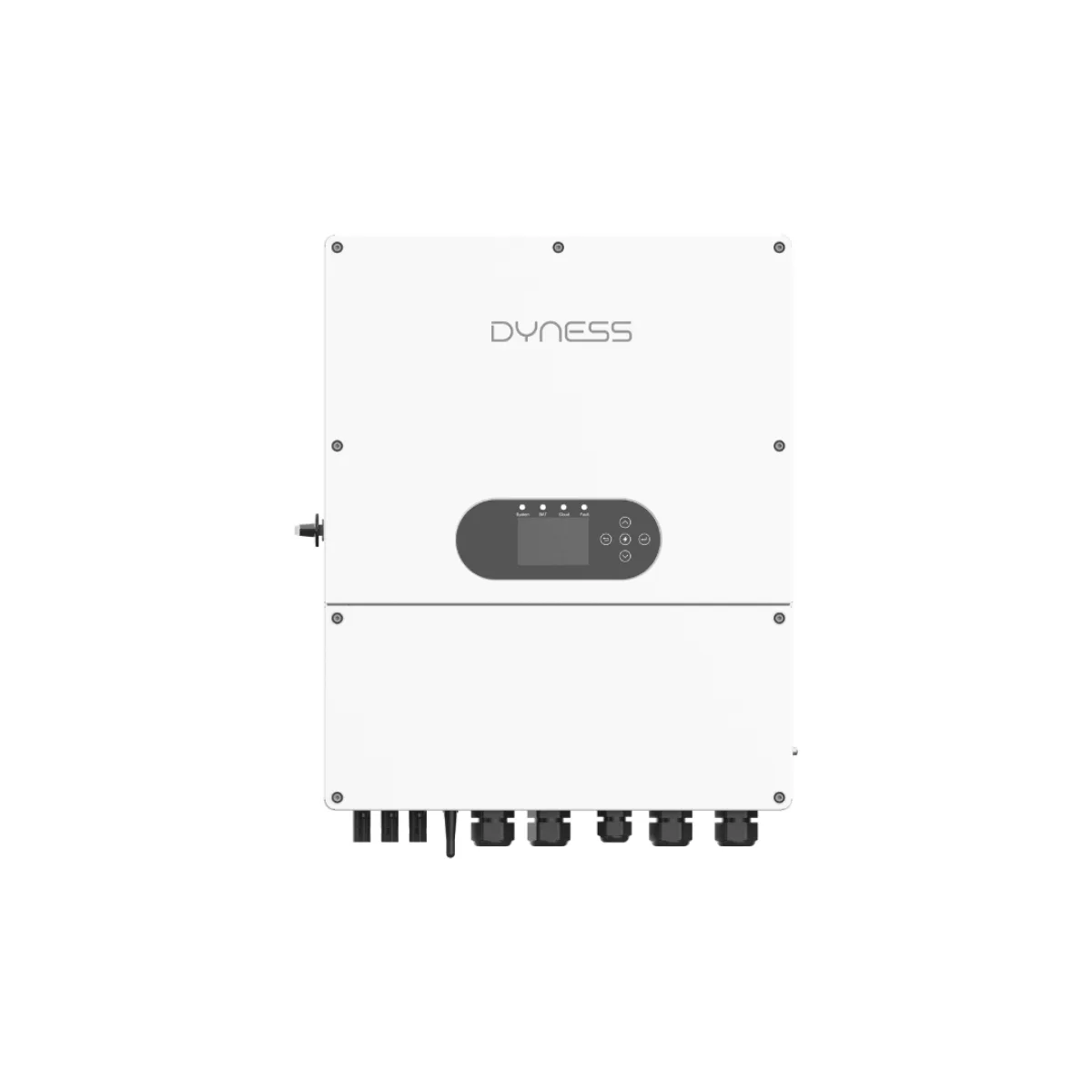
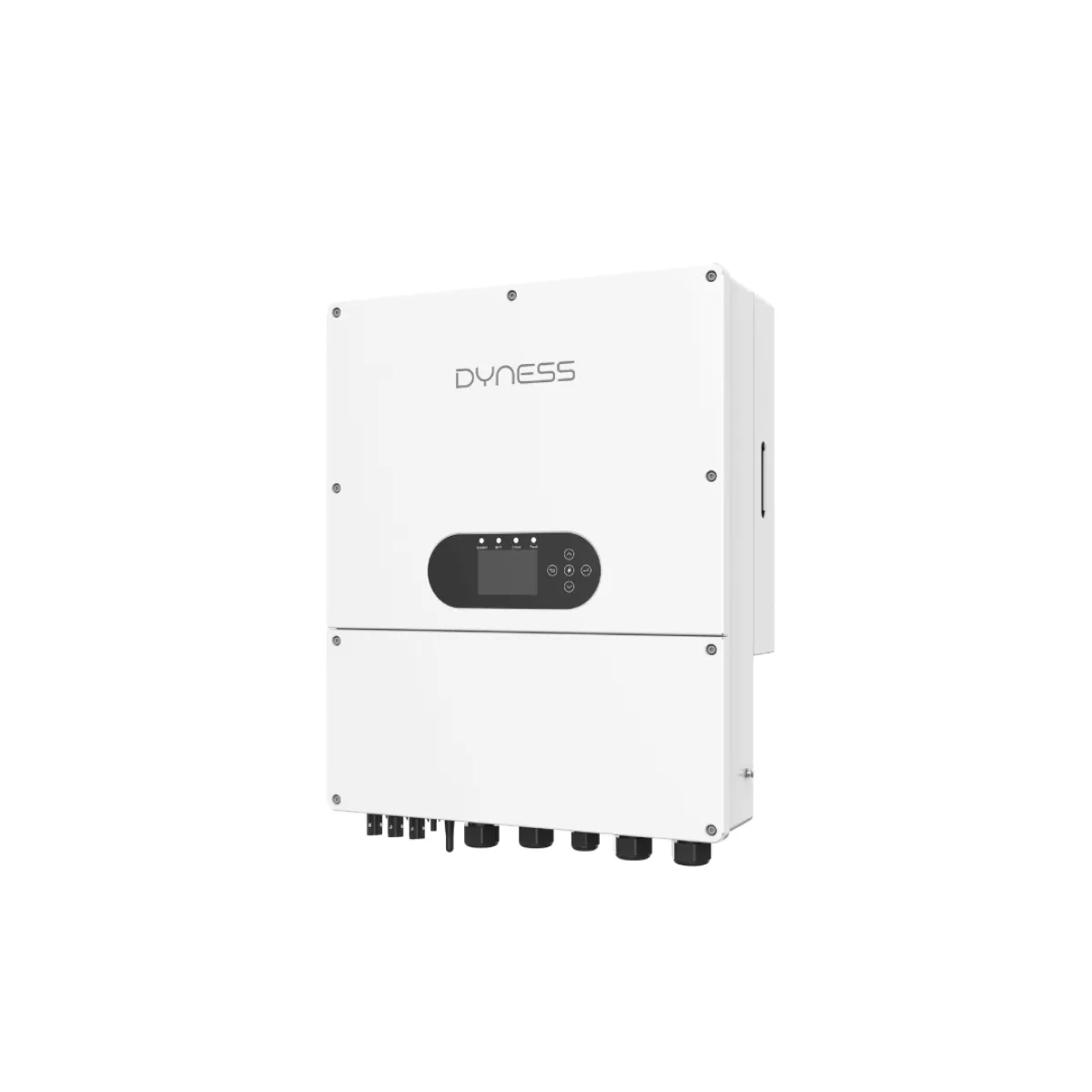
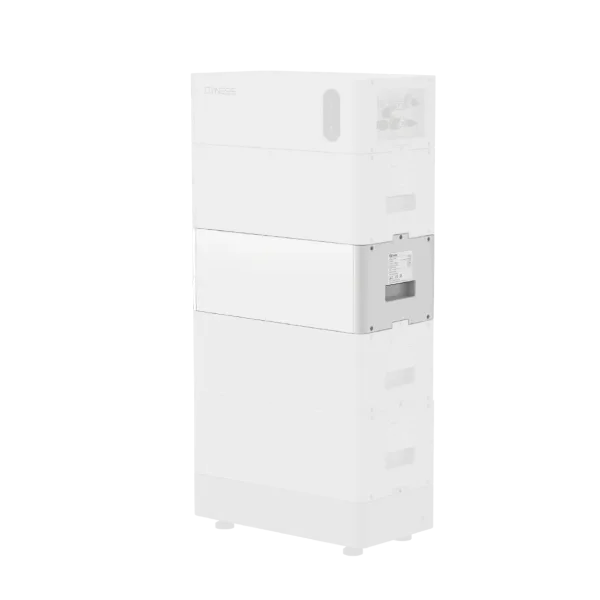
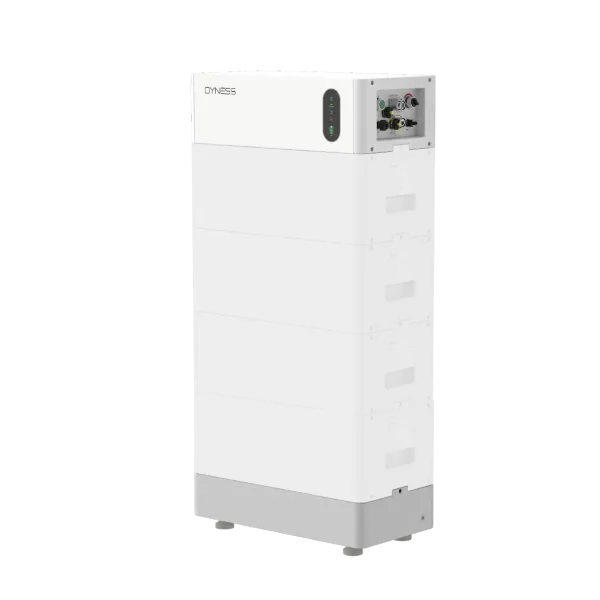
Dyness 5kW D5K-HT-A Hybrid HV 3-Phase Inverter
The HT-A series is Dyness’s three-phase, high-voltage hybrid inverter. This unit is the inverter itself: it manages solar power generation, the charging and discharging of the high-voltage battery, grid feeding, and backup operation. The battery is a separate product; the system accommodates a 120–750 V HV storage unit with a nominal voltage of 600 V.
The 5 kW version is the entry-level model in the series (5 / 6 / 8 / 10 / 12 / 15 kW), featuring a 10 kW PV input and two independent MPPT trackers, typically suited for roofs around 8–10 kWp.
What is it used for?
An average single-family home with a three-phase connection, where the roof has a capacity of around 8–10 kWp and electricity consumption is moderate. A typical combination is 10 kWp of PV and 10–20 kWh of storage capacity.
It’s a good choice for homes with a heat pump but where a high-power EV charger or workshop equipment isn’t part of the plan. It’s also suitable if the consumer has a three-phase meter but the actual load is low.
Asymmetric output per phase works here as well: up to 50% of the nominal power per phase, meaning a single phase can be loaded up to 2.5 kW with this model. In older homes with single-phase water heaters or appliances, this is a practical advantage, but the 2.5 kW limit must be taken into account.
Due to the 10 kVA power draw from the grid, the storage unit can be charged quickly during off-peak hours under a dynamic pricing plan.
How does it work?
The inverter manages two independent MPPT trackers, with one string per MPPT, for a total PV input of up to 10 kW. The input voltage is rated up to 1,000 V, the operating range is 80–950 V, the feed-in starts at 100 V, and the nominal PV input voltage is 750 V. An input current of 20 A and a short-circuit current of 30 A are permitted per MPPT.
The 80–950 V operating range and the 100 V input threshold are particularly useful in this power class. On a 10 kWp roof, you can divide the two strings into shorter sections, so that two areas with different orientations or varying degrees of shading can be assigned to separate MPPTs, even with strings consisting of 4–6 modules. The 10 kW PV input, compared to 5 kW AC, allows for a DC/AC ratio of 2.0, which provides longer periods of full-power operation in the morning and late afternoon.
The battery side accepts a 120–750 V range, with a nominal voltage of 600 V, and features CAN communication with the BMS. Maximum charge and discharge currents are 40/40 A, maximum charge power is 7.5 kW, and maximum discharge power is 5 kW.
In the event of a power outage, the switchover occurs in less than 10 ms. The backup port continuously delivers 5 kVA and can provide a 10 kVA peak (14.5 A) for one minute, resulting in a 200% overload capacity. This is the best overload ratio in the series and is particularly important for loads with high inrush current requirements.
Two features simplify commissioning. Thanks to the CT phase sequence self-correction, swapped current transformers do not cause measurement errors. Remote parameterization means that on-site visits are not required for subsequent adjustments.
Technical and System-Level Benefits
AC side: 400/380 V, 3L/N/PE, 50/60 Hz. Rated and maximum apparent power supplied to the grid: 5000 VA; rated and maximum output current: 7.6 A; maximum input current: 15.2 A; THDi <3%; power factor adjustable between 0.8 leading and 0.8 lagging.
Efficiency: max. 98.0%, European efficiency 97.2%.
Protection: islanding protection, PV insulation resistance measurement, PV polarity protection, battery polarity protection, built-in residual current monitoring unit (RCMU), AC overcurrent and overvoltage protection, PV DC disconnect, and DC Type II and AC Type III surge arresters.
Communication and integration: CAN to the battery BMS, RS485 to the EMS (Modbus) and external meter, Modbus TCP/RTU and SunSpec protocols, and Wi-Fi and LAN to the cloud. It also features RCR/DRED input, remote shutdown input, and dry-point output. Display options include LED and LCD, plus a mobile app.
Importantly, even the entry-level model is not stripped down: it includes the same set of protection and communication features as the 15 kW model, as well as the same zero-feed-in control. This means it can be installed even under grid permits that require limited or zero feed-in.
Operating temperature range: −30 to +60 °C; humidity: 0–100%; can be installed at altitudes up to 3,000 m. Cooling via an intelligent fan system, with a noise level below 40 dB. Weight: 27.2 kg; dimensions: 500 × 585 × 212 mm; wall-mounted design; IP66 protection rating.
Compliance: EN 50549-1, IEC/EN 62109-1&2, EMC IEC/EN 61000-6-1/2/3/4.
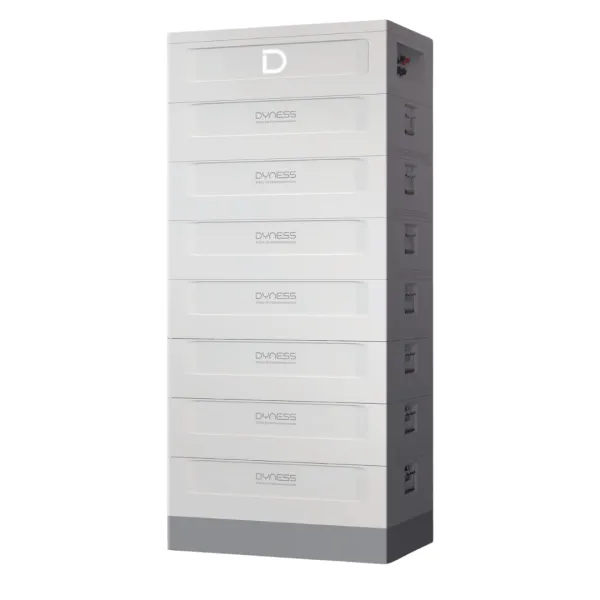
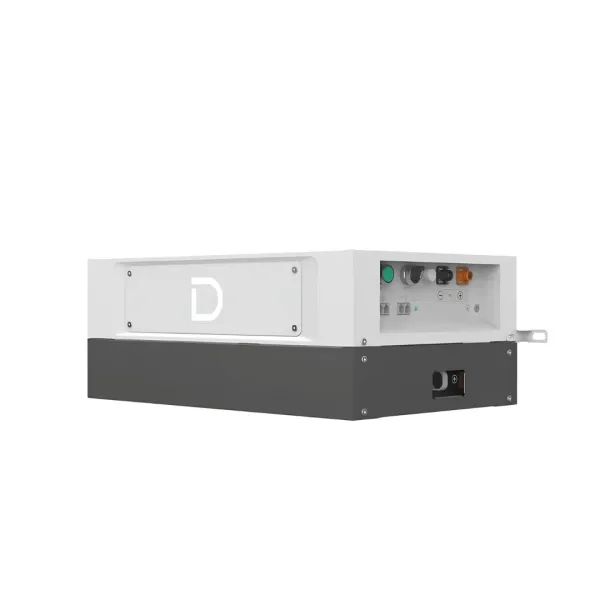
Compatible products from the SOLARKIT lineup:SBDU100 BMS and base,Stack 100 battery module,Stack 100 Pro PDU and base,Stack 100 Pro battery module,Tower Pro battery module,Tower Pro BMS and base.
Differences
The HT-A series offers six power levels, and the choice depends on two parameters: the PV input and the number of MPPT channels.
5 kW (this product): 10 kW PV, 2 MPPTs, 7.5/5 kW battery charge/discharge, 98.0% efficiency, 200% backup overload capacity.
6 kW: 12 kW PV, 2 MPPT, 9/6.6 kW, 98.1%.
8 kW: 16 kW PV, 2 MPPT, 12/8.8 kW, 98.1%.
10 kW: 20 kW PV, 3 MPPT, 15/11 kW, 98.2%.
12 kW: 24 kW PV, 3 MPPT, 18/13.2 kW, 98.2%.
15 kW: 30 kW PV, 3 MPPT, 22.5/16.5 kW, 98.2%.
The 5 kW model is the right choice if the roof is under 10 kWp, peak consumption stays around 5 kW, and the roof has no more than two orientations. If the roof approaches 10 kWp, you’ll need the 6 or 8 kW model, because the 10 kW PV input is a strict limit here.
If the roof has three orientations, do not choose this model. The third MPPT track is only available starting with the 10 kW model, and for many Hungarian tile roofs, this is a more important consideration than the power output itself.
The housing, weight (27.2 kg), dimensions, IP66 rating, and protection kit are identical across the entire series, so the installation effort is the same. Upgrading to a higher model does not entail higher installation costs.
Important to know
The inverter does not function as a storage system on its own: it requires a 120–750 V, 600 V nominal high-voltage battery with CAN communication. The compatible battery types and maximum capacity are specified in the Dyness compatibility list and the installation guide; these must be verified at the time of ordering.
This is an HV inverter. 48 V LV batteries, such as the Powerbox G2, are not compatible with it. If the customer has an LV storage system or plans to install one, a different inverter series is required.
The 10 kW PV input limit is the bottleneck for this model. If the customer plans to expand their rooftop system within two years, expanding the PV side will require replacing the inverter. This is the only parameter where the entry-level model truly falls short of the larger models.
The 10 kVA one-minute peak power is not a continuous value. When sizing for peak load, calculate using the 5 kVA continuous backup power.
A maximum of 2.5 kW can be loaded asymmetrically per phase. This must be verified for large single-phase loads, such as a 3 kW water heater.
It features fan-assisted cooling, which provides better performance under heavy loads but involves moving parts and dust accumulation. In dusty environments, periodic inspection of the ventilation openings is necessary.
SOLARKIT Reviews
This is the entry-level model in the series, and the good news is that it makes no compromises: it has the same set of protection features, the same communication and integration capabilities, and the same 80–950 V MPPT range as the 15 kW model. Only the power output and PV input are lower.
Two features set it apart from the rest of its class. One is the 200% backup overload capacity, which is the best ratio in the series: 5 kVA continuous plus 10 kVA for one minute. In a small home, this means the refrigerator, pump, or air conditioner will start up even in island mode. The other is the 100 V input threshold and the wide MPPT range, which allows even short strings to operate.
From an installer’s perspective, the entire series is housed in the same enclosure, so the installer only needs to learn one model for power ranges from 5 to 15 kW. This means a flatter learning curve and fewer opportunities for error, which is a real selling point for resellers.
If the customer has an 8–10 kWp roof, a 10–20 kWh storage system, and moderate energy consumption, this is the right choice, and it’s not worth paying more for a higher-capacity model. However, if there’s any uncertainty regarding a future roof expansion, recommend the 6- or 8-kW system instead. And if the roof has three orientations, go straight for the 10-kW system, because that’s where the third MPPT tracker comes into play, and this feature cannot be added later.